

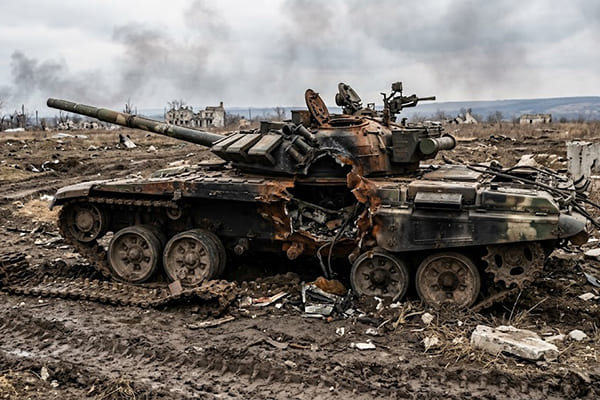

The New Imperative in Soldier and Armour Protection
Modern warfare is rewriting the logic of protection. Across recent conflicts, the battlefield has shown that survivability is no longer determined only by the ability to stop bullets. Fragments, blast effects, drones, top-attack profiles, electronic vulnerability, and the need for mobility have changed the protection equation for soldiers and armoured platforms alike. Advanced ceramics and composites have therefore moved from the laboratory to the centre of operational relevance. They are no longer niche materials; they are now among the most important enablers of future battlefield survivability.
The lessons are stark. The experience of high-intensity conflict, particularly in Ukraine, has underscored that a large proportion of casualties arise from fragments and blast rather than direct bullet impacts. This shifts the design emphasis away from just defeating rifle rounds toward achieving wider, smarter, and more adaptive coverage. In the Indian context, the aftermath of Operation Sindoor further highlighted the urgency of upgrading soldier protection and accelerating the domestic production of modern bulletproof systems.

The Threat Has Changed
The adversary faced by the modern soldier is no longer one-dimensional. Protection systems today must deal with a wide threat spectrum: drone-delivered fragments, mortar splinters, grenades, rifle armour-piercing rounds, heavy machine-gun fire, kinetic-energy penetrators for vehicles, and even the possibility of CBRN-related exposure. Each of these threats demands a different protective response. This is why armour can no longer be understood as a single plate or a single material. It is a layered system of materials, geometry, coverage, and integration.
At the soldier level, the challenge is not only to stop a rifle round but also to protect vulnerable body zones against fragments. Helmets, collars, yokes, deltoid protectors, groin protection, and shin guards all become part of the survivability architecture. At the platform level, the problem becomes even more complex, because vehicles must deal with APFSDS rounds, RPG threats, top-attack profiles, and electronic warfare vulnerabilities. The future of protection is therefore distributed, layered, and mission-specific.
Why Ceramics Matter
The case for advanced ceramics begins with physics. Ceramic strike faces such as boron carbide and silicon carbide are much harder than conventional armour steel, while being significantly lighter. When struck by a projectile, the ceramic does not simply absorb the hit. It erodes, blunts, and fractures the incoming penetrator, dispersing the impact energy. A backing layer — often based on polymers, composites, or ultra-high-molecular-weight polyethylene — then catches the residual fragments and reduces blunt trauma to the body.
This combination is what makes ceramic-composite armour so effective. It delivers a level of ballistic resistance that would be far too heavy if achieved solely through steel. Weight is not a secondary factor in protection; it is central to combat effectiveness. If armour becomes too heavy, soldier endurance declines, mobility suffers, and battlefield performance deteriorates. That is why boron carbide, with its exceptional hardness and very low density, has become such an important material in modern protective systems.

Transparent ceramics also point to future possibilities. Materials such as aluminium oxynitride can provide ballistic protection in vehicle windows and aircraft canopies while preserving visibility. This illustrates a broader truth: ceramics are not merely replacements for steel plates. They are enablers of a broader design transformation in how protection is conceived.
Geometry Is as Important as Material
One of the most important insights in modern armour design is that performance depends not only on what a system is made of, but also on how it is arranged. Geometry can dramatically improve weight efficiency, flexibility, and multi-hit capability. The same ceramic material may perform very differently depending on whether it is configured as a monolithic plate, a mosaic tile array, a cylindrical honeycomb, or an overlapping fish-scale structure.
This is especially important in an era in which multiple impacts in a confined area are increasingly common. A monolithic plate may be compromised after one hit in a localised zone. A tiled mosaic, by contrast, can isolate damage and preserve protection in adjacent zones. Bio-inspired fish-scale structures offer another advantage: they can conform to curved body surfaces and provide flexible multi-hit coverage in places where flat plates are ineffective.
This means the future of armour lies not simply in stronger materials, but in architected protection systems that combine material science with design intelligence.
Soft Armour Still Matters
If ceramics defeat bullets, soft armour defeats fragments — and fragments matter enormously on the modern battlefield. High-performance fibres, layered intelligently, are indispensable for protecting areas where rigid plates cannot be worn comfortably or continuously. Here again, materials matter, but architecture matters just as much. Fibre orientation, layering pattern, resin or thermoplastic matrix, and hybridisation all influence ballistic performance.
The next leap may also come from hybrid and unconventional materials. Natural fibre-based ballistic composites, when combined with established materials such as Kevlar, show promise for indigenous, lower-cost armour concepts. These should not be dismissed as peripheral experiments. They represent a potentially valuable avenue for India’s own resource-based innovation ecosystem.
The Frontier: Nano, Multifunctionality, and Adaptive Protection
The most exciting developments in armour science are occurring at the frontier where protection, sensing, and multifunctionality begin to merge. Nanomaterials such as carbon nanotubes and graphene are important not only because of their extraordinary mechanical properties, but because they could enable armour to become structurally intelligent. The same material system could provide strength, electromagnetic shielding, and real-time health monitoring of structural damage.
Other advanced concepts, such as shear-thickening-fluid armour, point toward protection systems that remain flexible in normal use but harden instantaneously under impact. This has major implications for areas like the neck, groin, joints, and shoulders, where traditional rigid armour is difficult to apply. Likewise, radiation-shielding composites could become increasingly important for high-altitude operations and future CBRN contingencies. Protection in the future will not be single-function; it will be adaptive and multifunctional.
Additive Manufacturing and the Logistics Revolution
Advanced armour is not only about defeating threats; it is also about how quickly protection can be produced, repaired, and adapted. Traditional ceramic armour is centrally manufactured, transported forward, and difficult to replace once damaged. Additive manufacturing could alter that equation by enabling distributed production of armour components closer to the point of need.
This matters because survivability is as much a logistics problem as it is a materials problem. If replacement inserts, plates, and modular protection elements can be produced or restored faster, the battlefield value of armour increases dramatically. The significance of additive manufacturing therefore lies not merely in fabrication novelty, but in resilience, response time, and supply-chain independence.
India’s Progress: From Research to Reality
India’s armour story is not one of absence; it is one of rapid but still incomplete acceleration. Over the years, institutions such as DRDO, DMRL, IIT Delhi, MIDHANI, and a growing network of private industry have built important capabilities in steels, ceramics, composites, and armour integration.
A major recent example is ABHED — Advanced Ballistics for High Energy Defeat — developed by DRDO and IIT Delhi. It uses indigenous boron carbide ceramic and polymer-based construction, has passed required trials, and offers modular 360-degree protection while remaining within demanding weight limits. Public reporting states that its variants weigh between 8.2 kg and 9.5 kg depending on the BIS threat level, making it a notable step forward in lightweight soldier protection.
At the vehicle level, Kanchan armour remains one of India’s most significant achievements in composite armour design. Advanced ceramic-based vehicle protection is also increasingly moving into production through technology transfers and industry partnerships, including work associated with wheeled armoured platforms and other future combat systems.
India also benefits from a maturing standards ecosystem. IS 17051:2018 has given the country its own performance framework for bullet-resistant jackets, which is important for both procurement clarity and industrial scaling.
The Gaps That Still Remain
Despite this progress, several gaps remain. The first is scale. Operational demand for protective systems still exceeds available supply by a significant margin. The second is multi-hit all-round protection, especially beyond the plate itself and across the full body. The third is validation across India’s harsh thermal envelope, from Siachen’s extreme cold to desert heat.
There is also a clear need to integrate CBRN resilience, smart sensing, and adaptive material systems into the next generation of armour. Finally, India must think ahead to exoskeleton-assisted soldiers and networked battlefield systems, because future armour will not exist in isolation from power, mobility, data, and load-bearing technologies.
The Way Ahead
The way ahead is clear. India needs a coordinated effort that links operational users, defence laboratories, academia, and industry into a sustained materials and protection ecosystem. The priorities are equally clear: multi-hit ceramic architectures, better soft-armour systems, adaptive materials, additive manufacturing closer to the field, smart structural monitoring, CBRN-capable protection, and future-soldier integration.
The material science exists. The institutions exist. The operational urgency certainly exists. What is required now is speed, scale, and coordinated investment.
In the final analysis, armour is not just about plates, fibres, ceramics, or composites. It is about ensuring that the soldier survives long enough to fight, adapt, and prevail. Advanced ceramics and composites are therefore not merely materials of protection; they are materials of combat power.
(This article is based on a talk given by Col Jitender Kaushik, of the Faculty of Studies, College of Military Engineering, Pune, on 7 April 2026 at the Advanced Materials & Additive Manufacturing seminar in New Delhi)