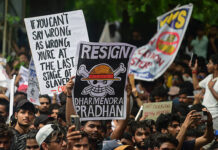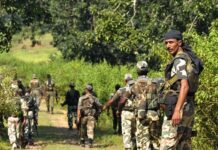

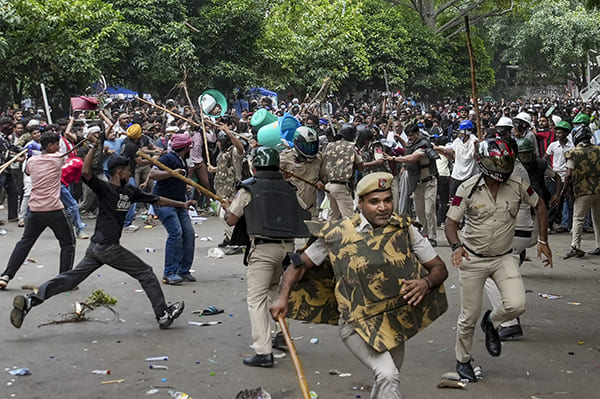

The protests to demand accountability from the government in the aftermath of the NEET paper leak commenced in June, developing into an indefinite sit-in at the Jantar Mantar. This culminated into a march to the Parliament on July 20, resulting in widespread violence in which a large number of protesters and security forces (SF) personnel were injured. Post the incident, the debate over the use of force has, understandably, focused primarily on allegations of excessive and disproportionate police action. This has become sharper after the police filed an affidavit in the Supreme Court (SC) on August 20. Such scrutiny is essential in a democracy to ensure that the SF exercise restraint in a public order contingency and use minimum force to bring the situation under control. However, there are authentic videos of pitched battles between both sides on mainstream and social media. These also show police personnel being surrounded, brutally attacked and, in some instances, subjected to what can reasonably be described as attempts at lynching. These visuals deserve the same scrutiny as videos showing police action against protesters. They should not be dismissed as an inconvenient part of the story. The rights of the men and women in uniform who were expected to stand between an unruly, violent crowd and the restoration of public order are being exceptionally given scant attention. With another march planned on September 5 in New Delhi, the issue assumes added importance.
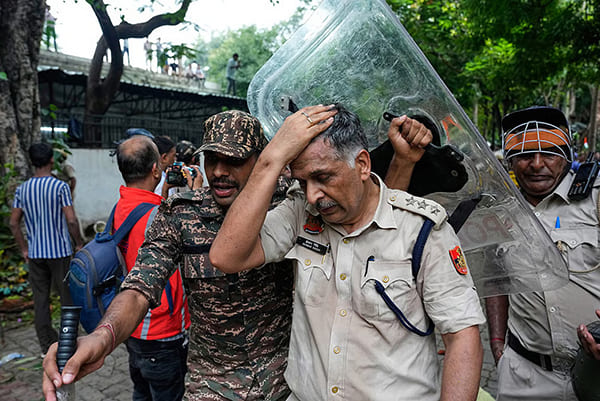
At the outset, it must be reiterated that this write-up is not intended to endorse or defend the establishment’s actions, whether through commission or omission. On the contrary, there are legitimate questions that must be answered – why the outreach to the protesters was inordinately delayed, why was the police response not sufficiently proactive in the initial stages, why was the crowd allowed to develop into a critical mass before decisive crowd-control measures were employed and why was the use of pellet guns not transparently acknowledged at the outset. These are serious issues, and the SC constituted committee should establish responsibility and attributability for decisions that may have unnecessarily escalated the situation. However, accountability is not one way street and the actions of the protestors, including causing severe injuries to the police personnel, should also be examined to arrive at a balanced perspective in this volatile and explosive situation.

The police have stated before the SC that the protesters refused to vacate the Jantar Mantar complex and no permission had been granted for the Parliament march. Therefore, the gathering and the attempt to march towards the Parliament were illegal by an unlawful assembly. Despite repeated requests and warnings by the police, protestors breached multiple layers of barricades and refused to comply with lawful directions in their bid to reach the Parliament. Disregarding these significant causative factors, the ongoing public discourse assumes that the protesters were exercising their legitimate democratic right to protest and that the police subsequently violated that right. That narrative becomes imperfect once a protest crosses the line and degrades into violence. The right to peaceful protest is fundamental. The right to attack another human being is not. The Bharatiya Nyaya Sanhita itself recognises the right of private defence of every person. That includes a policewoman. A police person does not surrender his fundamental right to life and bodily integrity merely because she is wearing a uniform. More importantly, the organisers and participants in a protest cannot distance themselves from violence by arguing that “criminal elements” infiltrated an otherwise peaceful demonstration. A large organised demonstration also carries a degree of collective responsibility for maintaining discipline within its ranks and ensuring that participants do not attack police personnel. In fact, the organisers should cooperate with the police to identify and isolate those who attempted to turn a peaceful demonstration into a violent confrontation. If they fail to do so, they cannot expect the entire burden of responsibility to fall upon the police.
Since the recommendations of the SC appointed committee to frame guidelines for graded use of force during disorderly protests will be applicable pan India, it should not narrowly focus on this incident. The case of J&K is particularly instructive. Agitational resistance manifesting in protests, stone throwing incidents and bandhs started in 2008, with the ISI of Pakistan attempting to replicate the tactics seen in Intifada II in Palestine. Engineered mass protests against the SF for alleged human rights violations, withdrawal of the Army and Armed Forces Special Powers Act were common, especially on Fridays. There were also a few incidents of terrorists joining the protestors and firing on the SF. The intent was to provoke the SF to retaliate, resulting in collateral damage to escalate the situation. The 2010 Kashmir unrest was a series of violent anti-India protests and riots that resulted in the deaths of over 100 civilians, mostly teenagers and young adults. Protests later broadened into anti-India rallies, demands for independence, and clashes over unrelated international events. The SF heavily used tear gas, batons and live ammunition during the peak of the crisis. Due to intense criticism over lethal casualties from live gunfire, the police and para military forces introduced 12-bore pump-action pellet shotguns in 2010 as an alternative crowd-control method. Therefore, if the pellet guns were used on July 20, this year by the SF as enshrined in their SOP, they followed the matrix of graded use of force. Surprisingly, there was intense pressure on the Army as well to acquire riot control equipment for such situations. It was rightly resisted, highlighting the use of the Army in its secondary role as an instrument of last resort and its doctrine and training based on “fire for effect”.
Moreover, in a rapidly deteriorating violent-crowd situation, an individual officer may have only seconds to decide whether he or his colleagues are in imminent danger. Judging that decision later from a video clip, without visualising what the officer could actually see and reasonably apprehend at that moment, risks producing an inherently distorted assessment. The proportionality and necessity of the response must, therefore, remain central to any investigation. But proportionality must be assessed against the threat actually confronting the officer and not against an ideal peaceful protest. This is where the present debate needs greater balance.
Courts, lawyers and the media have an important role in protecting citizens from state excesses. But protection of civil liberties cannot mean treating law enforcement personnel as people without rights. The police are also citizens. They have families, fears and physical vulnerabilities. The shield and helmet do not make them invulnerable. Indeed, if the state expects police personnel to confront violent crowds, it has an obligation to give them appropriate training, equipment, clear rules of engagement and competent leadership. Conversely, police leadership must ensure that personnel are not placed in situations where poor planning, delayed intervention or inadequate communication make violence more likely. The real lesson from this occurrence should, therefore, not be that police action is essentially suspect or that protesters are inherently innocent. It should be that both sides have rights and responsibilities. The right to protest is indispensable to a free society. So is the right of the person in uniform to return home safely after enforcing the law. The objective should not be to choose between the two. It should be to ensure that both perform their respective mandates without fear or unnecessary castigation.