

Fortifying the Defence Forces
Three major ongoing conflicts in the world — Russia-Ukraine, the Persian Gulf and Paliestine/Lebanon have driven home the enduring importance of the human resource. The lesson has been highlighted yet again that precision weapons, drones and artificial intelligence of technologically advanced militaries cannot by themselves replace trained soldiers. Behind the live TV coverage of missile strikes and drone swarms, the regular armies are grappling with shortages of manpower, declining morale, retention problems and the difficulty of sustaining prolonged operations. For India, which faces unsettled borders with both Pakistan and China, this is strategic caution that cannot be ignored as an academic debate.
Even the world’s preeminent military power, the US, is struggling. There are reports of low morale among sailors on USS Lincoln, currently stationed in the Middle East, which has been at sea continuously for over nine months. Reportedly, there are shortages of essential stores and rations on board. Earlier in 2004, there was a documented case of 18 US soldiers in Iraq who refused an order to drive a fuel convoy because they believed the mission was too dangerous, leading to an investigation. The incident was treated as a discipline issue. More recently, reports in the Iran war mention increased dissent and conscientious objection to undertaking bona fide military missions. There are increasing requests for early exits, non-renewal options, and medical separation. The US Army even missed its recruitment target by 15,000 soldiers in 2022 and continues to face a shortfall despite lowering fitness standards and offering signing bonuses up to $50,000. A RAND Corporation study attributes this to declining public trust in institutions, better civilian job markets, and a shrinking pool of medically and mentally eligible youth. If the world’s best-funded military cannot achieve its recruitment targets, we need to take notice.

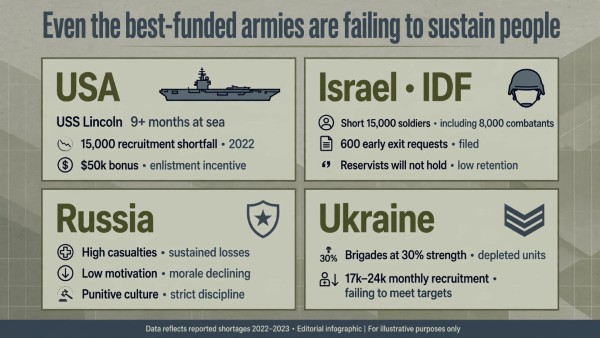
The Israeli army (IDF) is facing three linked HR issues: manpower shortages, declining motivation in some service categories and rising strain on mission execution as the force is being asked to do more with less. Apparently, combat units, reservists, and career officers are all under pressure. Le Monde reported that the IDF has warned it is short of roughly 15,000 soldiers, including 8,000 combatants, and nearly 600 personnel had asked to leave early. That kind of gap forces the army to stretch existing personnel, complicate rotations, and weaken retention. Motivation problems show up most visibly in recruitment for combat units and in retention of officers. Their Chief of Staff has warned that reservists “will not hold” if the burden continues, and that the army could struggle with even routine missions in the near future. Situationally, the army is trying to balance multi-front operations, expanded security tasks, and limited manpower, which increases the risk of fatigue, slower response, and reduced readiness. Undoubtedly, this is less of a short-term recruitment constraint and more a force-sustainment problem.
The Russia–Ukraine war offers the clearest evidence. The Russian army is facing extreme HR, motivation, and mission-accomplishment problems driven by high casualties, weak retention, poor discipline, and low troop motivation. These problems are not new, but the war in Ukraine has intensified them and made them operationally visible. Add to that a punitive military culture and suppression of realistic information. Russia’s problem is not just manpower quantity but force quality, motivation, and sustainability. Even an autocracy with fewer political constraints cannot indefinitely substitute money and coercion for a sustainable personnel model. Ukraine’s experience is also revealing. Ukraine has repeatedly expanded its mobilisation base and lowered the eligible age for service. By late 2025, many frontline brigades were operating at around 30 per cent of authorised strength, with monthly recruitment of 17000–24000 failing to offset casualties, desertion and absence without leave. There is a vicious cycle of losses forcing rushed recruitment, rushed recruitment lowering average quality and cohesion, undermining combat performance.
Other examples reinforce the pattern. European countries that sharply reduced their defence forces after the Cold War are now reconsidering those decisions. Germany, Poland, Sweden and others have announced plans to expand their military strength, improve reserve systems and increase defence spending. Sweden, which had suspended conscription, revived it in response to a deteriorating security environment. Even states that once assumed major conventional wars were unlikely are rebuilding manpower structures.
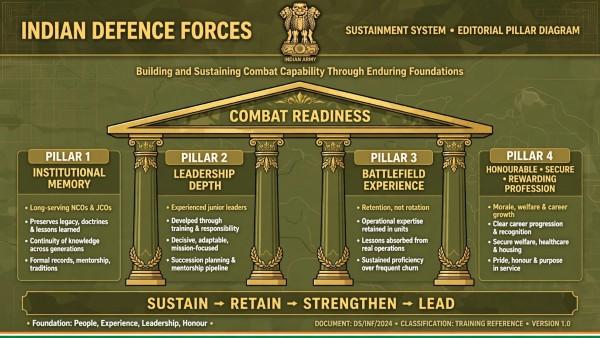
The security challenges facing India are varied and complex. The defence forces have multi-front obligations, besides being heavily committed in internal security tasks. Rapidly changing technology makes systems obsolete faster. While we may get all the technology and resources to attain the desired force goals, we will need to continuously upgrade the threshold level of the soldiers and leaders to handle these systems so as to minimise the mismatch between man and machine. The 8th Pay Commission offers a rare opportunity to signal that soldiering remains an honourable, secure, and rewarding profession and not a fallback option. It would be in the fitness of things to nurture and expand the existing sustainment model of the defence forces as also incentivise high-quality youth to volunteer for service to the nation. If the Indian military fails to attract and retain quality manpower today, its effect would only be felt when it fails to acquit itself creditably in a future mission. Understandably, the Services have given their recommendations to modify the Agnipath scheme to restore institutional memory, leadership depth, and battlefield experience that only long-serving soldiers provide. The Pay Commission must support these suggestions and ensure that when that moment arrives, India’s soldiers are neither exhausted nor underpaid and undertrained, but ready.