

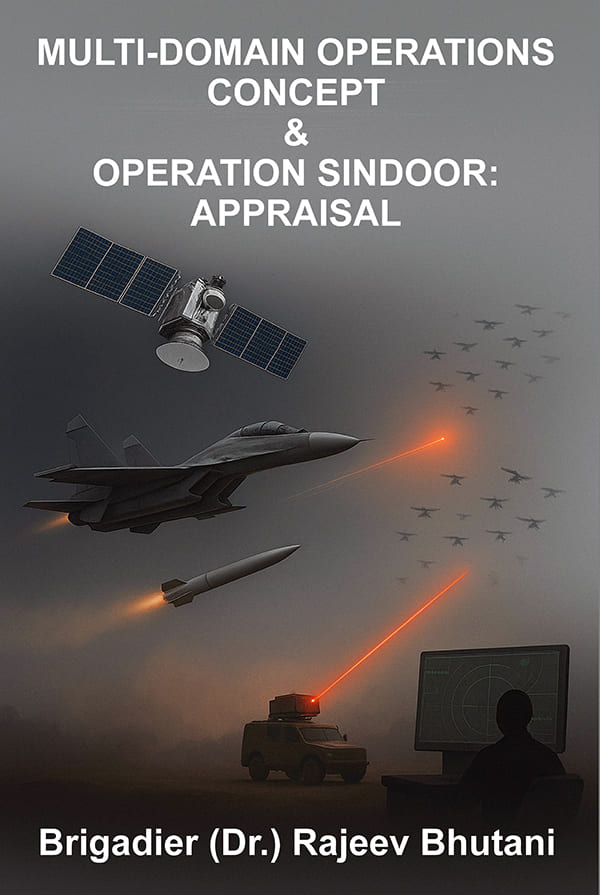

Brigadier (Dr.) Rajeev Bhutani (Retd.)
Self-published by the author
ISBN: 9789334375879
Price: ₹1395
Hardback, 211+ pages
Email: rajeev.deepa19@gmail.com
Multi-Domain Operations (MDO) is an emerging concept that most modern militaries worldwide are working to integrate into their warfighting doctrines. The key domains encompassed in the concept include the physical domains—land, maritime, air, and space—the electromagnetic spectrum (EMS), which includes cyberspace, and the cognitive/human domain. Unlike the integration and coordination achieved by joint forces in the existing system, MDO aims to deter and defeat adversaries in operations below armed conflict, during armed conflict, and in the post-conflict phase of returning to competition.

At a time when the United States and China are experimenting with various facets of the concept, either overtly or through proxies by providing them technologies, India found an opportunity through Operation Sindoor to test and validate its warfighting concepts and technologies. It was the first instance of non-contact kinetic warfare in which the Indian military achieved the desired political aim without mobilising its formations or physically crossing borders—neither by troops nor by aircraft. India showcased its Aatma Nirbharta (self-reliance) in defence technology and demonstrated its prowess in both offensive and defensive capabilities—drone-centric warfare, resilient and responsive air defence, long-range precision weapons, loitering munitions, and electronic warfare. Operation Sindoor has established a new benchmark in India’s fight against terrorism and set a new parameter and “new normal” for future operations.
The book is structured in two parts: Part I – Multi-Domain Operations Concept and Part II – Operation Sindoor: Appraisal. The United States pioneered the development of the Multi-Domain Battle (MDB) concept in 2015–16, which later evolved into the Multi-Domain Operations (MDO) concept by December 2018. Although the MDO concept is yet to mature into a fully functional warfighting doctrine, it now guides the transformation and modernisation of the US Armed Forces and their peers. China is known to be mirroring the same with its own “Chinese characteristics.”
Part I covers the evolution of the concept in the United States and China, defines the concept primarily derived from US philosophy, explores China’s All-Domain Operations concept, examines limitations of the MDO framework, and discusses India’s challenges and options.
In Part II, after explaining the genesis of India’s problem with Pakistan, the author appraises Operation Sindoor against the backdrop of the MDO concept. Although multiple domains were addressed during Operation Sindoor through coordination and integration among the armed forces and various government departments and agencies, the MDO framework as a concept remains a distant goal. Regarding Pakistan, much of its response was propaganda through influence operations. The author effectively debunks Pakistan’s claim of downing five to six Indian fighter jets on Day One of Operation Sindoor by exposing glaring errors in the technological hypothesis developed by Mr. Michael Dahm, which was widely cited by magazines and newspapers supporting Pakistan’s false narrative.
Drone-centric warfare, multi-layered and integrated air defence, and target-centric warfare employing precision weapons—visible aspects of Operation Sindoor—are covered in comprehensive detail for both India and Pakistan. The dominant role played by Aatma Nirbharta (self-reliance) in defence and the success achieved by indigenous weapons strengthened the government’s resolve to promote it further, a theme well-articulated in the book. The space, EMS, and human domains have also been given due significance.
The hallmark of the book lies in the author’s lucid exposition of Bharat’s strategic culture, which inspires its military ethos. He emphasises that India’s values are indigenous and not borrowed from any other country.
This book, the result of extensive and detailed research by Brigadier (Dr.) Rajeev Bhutani, could not have come at a more opportune time—when nations are actively developing and transforming their forces around the MDO concept. It will be of immense value to military professionals, researchers, scientists and engineers developing defence systems in government, public, and private enterprises, as well as policymakers.