

The Indian Army has initiated a landmark move in its modernization drive by floating a Request for Information (RFI) for the procurement of 5,000 tethered drone systems, signaling massive growth in persistent surveillance capabilities and technological self-reliance. Below is a comprehensive analysis covering all facets of this tethered drone requirement.
Projected Requirement for Tethered Drones

The Technology Perspective and Capability Roadmap (TPCR) 2025 directly mentions the requirement for 5,000 tethered drones, designed for round-the-clock surveillance in high-altitude operational areas up to 18,000 feet. The Army has clearly articulated operating norms—these drones must work in extreme temperatures ranging from −50°C to +45°C and deliver up to 9 hours of persistent aerial surveillance in tethered mode, vital for both border regions and forward posts.
Tender Requirements
The latest RFI calls for 5,000 tethered drone systems, reflecting immediate operational needs for surveillance, both day and night, with enhanced data relay and communications support.
The tender documents specify the altitude, endurance, payload, data security, and ruggedization criteria. Companies need to demonstrate proven operational deployment in similar environments. Requirements include high wind resistance, encrypted communications, failsafe systems for power and control, and modular payloads for different mission profiles, including EO/IR cameras, radar, and radio relays.
Some of the important specifications are as follows:
- Operating Altitude: Up to 18,000 feet—securing supremacy in the most challenging mountainous regions.
- Environmental Extremity: Functioning from a frigid −50oC to a scorching +45oC.
- Surveillance Endurance: A minimum of 9 hours of continuous flight in tethered mode.
Indian and global OEMs are invited, with an explicit preference for indigenous manufacturing under Make in India and offset clauses for global buys. This large-scale procurement is highly likely to trigger India’s mandatory Defence Offset Policy. Foreign OEMs must reinvest 30% of the contract value back into India via avenues like Joint Ventures (JVs), Transfer of Technology (ToT), or co-manufacturing. The 30% Offset Obligation applies to all ‘Buy (Global)’ capital acquisitions valued at ₹2,000 Crore (approx. $240 mn) or more.
Employment and Operational Use
Tethered drones are to be deployed along the Line of Control (LoC), Line of Actual Control (LAC), and Siachen, giving persistent overwatch in difficult terrain where conventional deployments are challenged.
Used in network-centric operations, tethered drones can function as airborne radio and data relays for forward units.
Some advanced deployments include jammers and electronic warfare payloads to disrupt hostile drones or signal.
Contemporary Success Stories in Conflict Zones
Ukraine: Tethered drones have been instrumental in trench warfare, offering persistent reconnaissance and communications relays for forces under constant threat, with minimal risk of power/battery shortages or loss due to electronic warfare.
Israel: Used extensively for border surveillance, anti-infiltration, and integrating with automated searchlights and long-range sensors.
Indian Deployments: The Army is already fielding limited numbers in sensitive zones, reporting enhanced situational awareness, reduced intrusions, and successful coordination in joint operations.
Leading Indian Manufacturers in Tethered Drones
BEL. Bharat Electronics Limited has launched multiple tethered UAV models tailored for defence surveillance and communications in harsh conditions. The BEL’s tethered UAV system is a hexacopter designed for high-endurance surveillance and monitoring, It is capable of rising to 100 meters, providing 6 hours continuous operation per sortie (with a rest cycle for cooling). It offers Electro-optic infrared (EO/IR) sensors for both day and night operations, with surveillance range up to 2 km in daylight, 1 km at night. It can be launched from ground vehicles, ships, or static positions for “virtual mast” surveillance, perimeter monitoring, and border security. It has emergency battery operation in case of power failure and modular payload options.
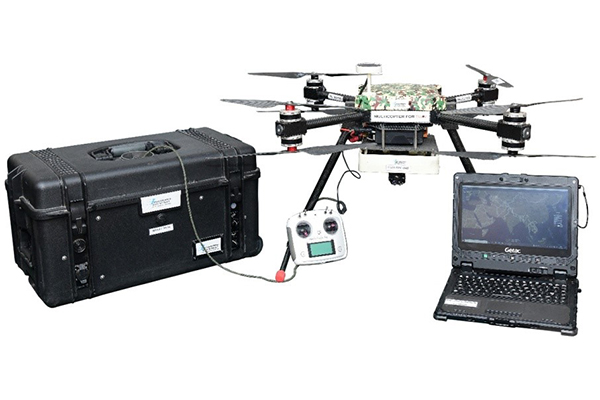
Dhaksha Unmanned Systems. It provides rugged and modular tethered UAV systems under the DH-Tethered UAV series, supporting both military and police applications. The DH-Tethered UAV is of hexacopter design, operating at heights of 100 meters; 24-hour endurance on continuous power supply, 1.5 kg payload, 20 km/h wind resistance. It has a combined EO and thermal camera, gimbal and video stabilization, day/night persistent tracking. It can be assembled in <10 minutes, and is foldable for compact storage. It has direct linking to command and control systems, indigenous winching enclosure, automatic winching and power management.
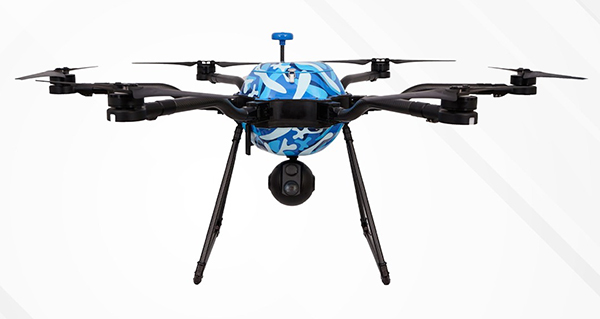
NewSpace Research & Technologies. The Nimbus Scope model is their flagship tethered drone, developed for super high-altitude and persistent ISR. Its key features are – Twin aerial vehicles per system, up to 200 feet altitude, at least 6 hours continuous tethered operation, 45 mins untethered. It has advanced EO and IR sensors, modular payloads for surveillance and communication. With portable GCS, robust generator, tether/winch station, backup batteries, it is optimized for high-altitude environments such as the LAC.
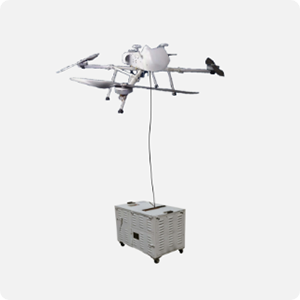
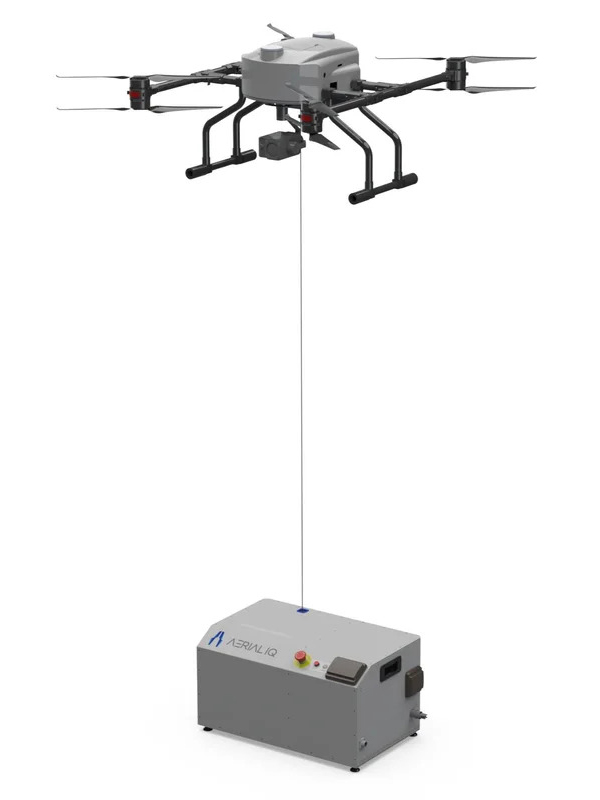
AERIAL IQ. The Aviral tethered drone, marketed as India’s leading persistent surveillance platform, has long airborne endurance (reported up to 24 hours by product coverage), is immune to jamming with fiber-optic tether, autonomous flight/landing, remote operation from vehicles/vessels. It has high configurable payload capacity—EO/IR sensors, radios, tactical communications modules. It is designed for rapid fielding, mobile units, and secure data relaying for military, fire, and emergency services.
Foreign Players
The leading foreign companies best known for tethered drones include Elistair (France/USA), Hoverfly Technologies (USA), Drone Aviation (USA), Fotokite (Switzerland), DJI (China), and Novadem (France). For policy reasons, DJI will not be eligible to collaborate.
Elistair (France/USA). Widely regarded as the global leader in tethered drone solutions, offering award-winning products like the Orion 2 for defense, law enforcement, and industrial use.
Hoverfly Technologies (USA). Specializes in advanced tethered drone systems designed for persistent surveillance and security in harsh environments.
Drone Aviation (USA). Known for its tactical tethered drones used by military agencies for persistent observation.
Fotokite (Switzerland). Renowned for actively tethered drones used in public safety, emergency response, and fire departments worldwide.Novadem (France). Provides tethered drone systems for law enforcement and defense customers, especially in Europe.
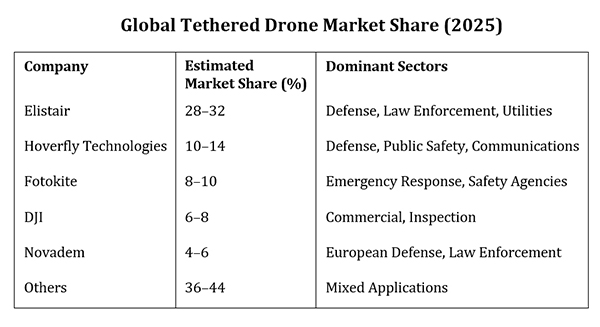
Globally, Elistair is consistently identified as the market leader for tethered drones, holding a substantial share especially in defense and security applications. Hoverfly Technologies and Fotokite follow as significant players with strong presences in North America and Europe, respectively. DJI possesses a notable share in commercial and inspection sectors but is not dominant in the defense market.
Conclusion This procurement not only sets new standards in drone endurance and sophistication but is also poised to transform India’s defence manufacturing ecosystem, leveraging the defence offset policy to bring in new investments, JV opportunities, and advanced technological capabilities for indigenous industries. The scale and ambition of the Indian Army’s tethered drone programme are set to make it one of the largest deployments globally, placing India at the forefront of persistent surveillance and unmanned defence technology.