

Cost of Inaction in Bangladesh, Nepal
In the volatile landscape of South Asian countries around India, the military’s role in internal crises is both constitutionally defined and politically sensitive. The summer of 2024 and 2025 presented critical moments to test the civil-military frameworks that define democratic governance. Recent events in Bangladesh and Nepal-confronted with massive Gen Z-driven protests-have exposed a troubling trend: armies that hesitate to act when ordered, allowing unrest to escalate and civilian authority to erode. This stands in stark contrast to the Indian Army, which has consistently upheld its apolitical ethos, professional conduct and constitutional mandate, even in the most politically charged situations.
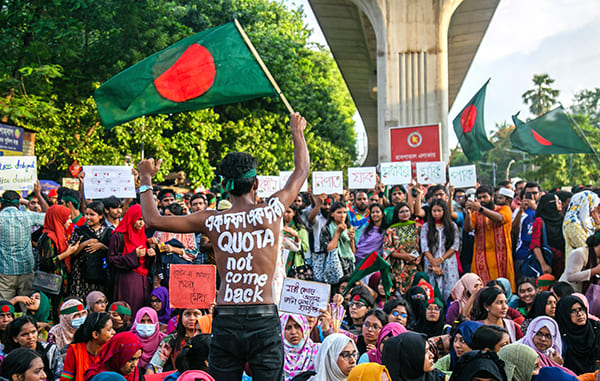
In Bangladesh, Prime Minister Sheikh Hasina’s government faced the “Job Quota” protests since early July 2024 that spiralled into anti-government uprising. The army was formally deployed at midnight July 19. Despite being deployed on July 19, the Bangladesh army exhibited considerable reluctance to take effective measures in the initial stages to bring the situation under control and prevent the protesters from marching towards Dhaka. Widespread violence led to attacks on minorities, wrecking of public property, including Indira Gandhi Cultural Centre in Dhaka, ransacking business establishments, destruction of the Banglabandhu museum besides others. This allowed the situation to become uncontrollable.

In a significant development, on the evening of August 3, over two weeks after the initial deployment, the Army Chief, General Waker-Uz-Zaman held a meeting with his generals and made a pivotal decision: the military would not open fire on civilians to enforce the curfew that Prime Minister Hasina had called for. This represented the military effectively disobeying civilian authority by deciding which orders to follow and which to refuse. While the Army’s humanitarian concern of collateral civilian deaths was understandable, inaction violated a fundamental principle of civil-military relations: once a civilian government orders military deployment, the military executes that order or resigns in protest. It does not selectively comply. The consequence was that Hasina, losing military support, was forced to resign on August 5, not because her order was unconstitutional, but because the military refused to enforce it. This represents a subtle coup d’état, where the military effectively vetoed civilian authority by refusing orders. Whether Hasina was autocratic or her policies were parochial become irrelevant; the mechanism through which she was removed-military refusal to obey civilian orders-violated democratic principles of civil-military relations.
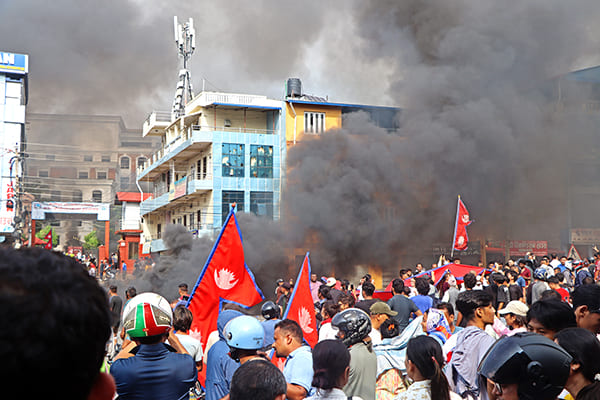
Nepal’s experience in 2025 mirrored Bangladesh’s trajectory. Protests erupted over digital censorship, evolving into broader anti-corruption demonstrations again led by Gen G. The youth was frustrated with unemployment, economic inequality, and endemic corruption. Again these protests engulfed the whole country. As demonstrations intensified, Prime Minister Oli’s government faltered. The government in Nepal called out the army to maintain law and order sometimes on the night of September 8-9. On the morning of September 9, the Army Chief with other top civilian functionaries met at the Prime Minister’s residence. During this crucial meeting Oli was informed that the situation had spiralled beyond control. Reports indicate that the Army Chief Sigdel advised Oli to resign, stating that the military could only stabilize the country if the Prime Minister relinquished power. Initially reluctant, Oli eventually agreed to step down. By early afternoon on September 9, protesters had vandalized the Parliament building, other public and private property. The army had several units located within walking distance of critical government buildings but hesitated to intervene to protect the Parliament, Supreme Court, and other important and historical structures from being set ablaze.
In both cases, Bangladesh and Nepal, the consequences were predictable: loss of control, regime collapse, and a vacuum of authority. The constitutions and statutes of Bangladesh and Nepal clearly define the military’s secondary task: to assist civil authorities in times of crisis. This mandate is not discretionary-it is binding. The military’s failure to act decisively when ordered undermined democratic stability and emboldened agitators. The core issue in Bangladesh and Nepal was not lack of capability-it was the exercise of discretion where none was warranted. Armies are not courts. Their role is not to adjudicate the correctness of government orders but to execute them within the bounds of legality and national interest. When armies begin to weigh the political implications of orders, they risk becoming political actors themselves. This undermines civilian supremacy, erodes public trust, and destabilizes democratic institutions. This is particularly dangerous in fragile democracies, where institutional checks are weak and public sentiment volatile. Military hesitation can embolden agitators, weaken governance, and invite external interference
India’s experience offers a compelling counterpoint. The Indian army has long been recognized for its secular, apolitical conduct and disciplined execution of government directives. During Operation Blue Star in 1984, the army was ordered to clear Sikh separatists from the Golden Temple, a mission fraught with religious and political sensitivities. The army did not hesitate. It acted swiftly, fulfilling its constitutional duty without passing judgment on the political context. Similarly, in the aftermath of the Godhra riots in 2002, the Indian army was deployed to restore public order. It moved decisively, securing affected areas and preventing further violence. In both cases, the army did not sit in judgment-it acted as the stabilizing force it was meant to be. Once a government order is given within constitutional parameters, the military’s professional obligation is execution with discipline and competence. The events in Bangladesh and Nepal underscore the urgent need to reaffirm civil-military boundaries. Democracies must ensure clear protocols for military deployment in internal crises, training and doctrine that reinforce apolitical conduct. India’s model, despite its own challenges, offers valuable lessons. The Indian army’s disciplined recognition of supremacy of civilian authority has helped preserve democratic stability even in moments of deep national crisis. When armies hesitate, nations falter.