

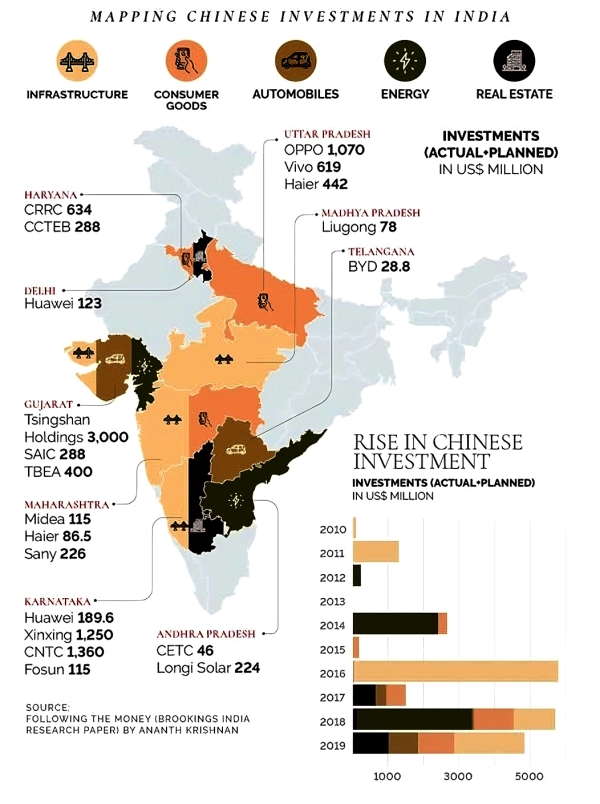

Chinese investment in India spans various sectors such as technology, manufacturing, infrastructure, and energy. Officially, the Indian Ministry of Commerce reports a stock of $2.5 billion in Chinese investments, but this figure is considered undervalued as it does not account for investments routed through third-party countries like Mauritius and Singapore. Data from the China Global Investment Tracker suggests that cumulative Chinese investments in India are closer to $17 billion over the period 2007-2020.
Fully Owned Chinese Companies in India

Fully owned Chinese companies operate in India, particularly in electronics, mobile manufacturing, and other industrial sectors. These companies have established manufacturing units and local operations to cater to India’s large consumer base.
Implications of Chinese Investments
• Economic Integration: Chinese companies have embedded themselves deeply into India’s technology and consumer markets, particularly through investments in startups and manufacturing.
• Geopolitical Concerns: Given border tensions between India and China, these investments have raised concerns about economic dependence and security risks.
• Regulatory Challenges: India has tightened FDI norms for countries sharing borders post-2020, slowing down new investments from China.
• Market Influence: Chinese companies dominate sectors like smartphones (72% market share), creating significant economic leverage.
While Chinese investments have contributed to India’s economic growth, they remain a point of contention due to geopolitical sensitivities and concerns about strategic dependencies.
Investment Comparison From Other Countries
Chinese investments in India are relatively smaller compared to those from other major countries, yet they are strategically significant due to their concentration in high-growth sectors like technology, electronics, and infrastructure. Their scale is dwarfed by contributions from other major economies like Japan and the U.S., which offer greater diversification and long-term partnerships across multiple industries.
Here’s a comparison of Chinese investments with other countries and the implications:
• FDI Stock: Official figures place Chinese investments in India at $2.5 billion, though estimates including indirect investments suggest a total closer to $17 billion.
• Key Sectors: Chinese investments are concentrated in electronics (e.g., Xiaomi, Vivo), mobile manufacturing, infrastructure (e.g., Sinosteel, Sino Hydro Corporation), and technology startups (e.g., Alibaba’s stake in Paytm and BigBasket).
• Dominance in Consumer Electronics: Chinese companies like Xiaomi and Vivo dominate the Indian smartphone market, collectively holding over 72% of market share.
Japan: Japan has invested $42.55 billion in India from April 2000 to March 2024, making it the fifth-largest FDI contributor. In 2023 alone, Japanese FDI exceeded $5 billion, focusing on sectors like automobiles (Suzuki, Toyota), infrastructure (high-speed rail), and electronics manufacturing.
United States: The U.S. is one of the largest investors in India, with cumulative FDI exceeding $50 billion. American companies are prominent in technology (Google, Amazon), defense, and pharmaceuticals.
European Union: EU nations collectively contribute substantial FDI to India across diverse sectors like renewable energy, automotive manufacturing, and financial services.
The implications of Chginese investments in India are as follows;
Strategic Leverage: While Chinese investments are smaller compared to Japan or the U.S., they are concentrated in critical sectors like technology and consumer goods, giving China significant economic leverage.
Geopolitical Concerns: India’s tightened FDI norms since 2020 reflect concerns about national security and dependency on Chinese capital.
Economic Diversification: Countries like Japan and the U.S. provide broader sectoral diversification compared to China’s focus on electronics and infrastructure.
China-Plus-One Strategy: India is actively attracting investments from other nations as part of this strategy to reduce dependency on China.
How is Chinese Investment Regulated in India
The Indian government has implemented stringent regulations for Chinese Foreign Direct Investment (FDI) due to security concerns and geopolitical sensitivities. These measures were introduced in April 2020 through Press Note 3 (Pn3), which mandates prior government approval for all investments from countries sharing land borders with India, including China.
The key regulations for Chinese FDI in India are as follows:
Mandatory Government Approval. All investments originating from China, or where the beneficial owner is Chinese (directly or indirectly), require prior approval from the Indian government. This applies to new investments, infusion of funds into subsidiaries, and share transfers within Chinese group companies. Approval is required regardless of the sector, although sensitive sectors like defense, telecommunications, and private security face additional scrutiny.
Security Clearance. Investments in sensitive sectors are subject to clearance by the Ministry of Home Affairs (MHA), which can extend the approval process by 1-2 weeks beyond the standard 10-14 weeks.
Restrictions on Portfolio Investments. Since 2023, foreign portfolio investors (FPIs) with significant Chinese holdings must disclose ultimate beneficial ownership to obtain registration from the Securities and Exchange Board of India (SEBI). Applications from Chinese-linked FPIs face enhanced scrutiny.
Exceptions. Existing investments by Chinese companies are not impacted by these rules unless additional funds are infused or shares are transferred within group companies. Multilateral banks or funds in which India is a member are exempt from these restrictions.
Sector-Specific Rules. While 100% FDI is allowed in several sectors under the automatic route, investments from China must follow the approval route even in sectors otherwise open to automatic investment. Sensitive sectors have additional conditions.
Some of the implications of this policy are as follows;
- The approval process for Chinese FDI now takes 10-14 weeks or longer, significantly delaying business operations compared to pre-2020 norms.
- Law enforcement agencies closely monitor Chinese companies for compliance with tax, customs, and security regulations.
- Many Indian startups previously benefited from Chinese capital through venture funding. These restrictions have reduced access to such funding, pushing startups to seek alternative sources.
- India’s regulatory framework for Chinese FDI reflects its cautious approach to balancing economic opportunities with national security concerns. While these measures have slowed down Chinese investments, they aim to safeguard India’s strategic interests amidst geopolitical tensions.