
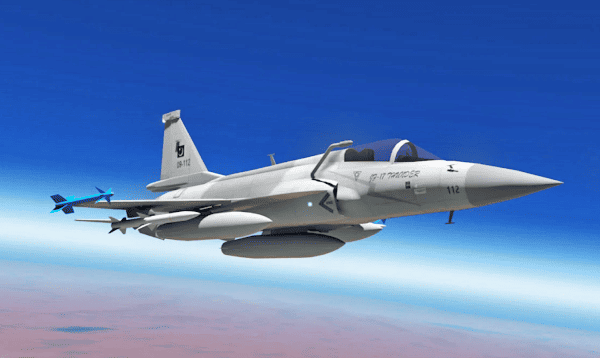

The PFX Programme and JF-17 Block III as the Bridge
Pakistan’s PFX (Pakistan Fighter Experimental) programme—publicly showcased at IDEAS 2024— is framed as a 4.5 gen leap focused on sensor, electronic warfare (EW), and avionics sovereignty. This article explains the programme’s aims and architecture, traces the JF-17’s evolution to Block III (KLJ-7A AESA radar, expanded EW/defensive aids, modern cockpit and HMD/S), and outlines weapons options and export context.
Over the past two decades, the Pakistan Air Force (PAF) has modernised along three reinforcing lines:

(I) Recapitalising legacy fleets through co-development and licence production,
(ii) Growing airborne sensing and battle management capacity, and
(iii) Iterating avionics faster than airframes.
The CAC/PAC JF-17 programme replaced ageing A-5/F-7/Mirage types and, crucially, established a domestic assembly and upgrade base at PAC Kamra. In parallel, PAF added AEW&C capacity (Saab 2000 Erieye and Chinese ZDK-03), tightening the sensor-to-shooter chain and informing doctrine for distributed air defence and strike control. More recently, the induction of the J-10C in 2022 provided a medium-weight node with advanced radar and weapons to complement the JF-17’s light/affordable mass.
Against this backdrop, the Pakistan Fighter Experimental concept (PFX) was presented at IDEAS 2024 in Karachi. PFX is framed as a 4.5-generation push expected to conclude its initial development cycle before decade’s end. Rather than a clean-sheet stealth jet on day one, PFX is positioned as an integration and sovereignty programme: drive ownership of the high-value stack – AESA radar, electronic warfare (EW), mission computing, and secure national datalinks – while using the JF-17 industrial line as the pragmatic launch pad.
Concretely, PFX is already moving in near-term spirals via an operational upgrade track colloquially dubbed PFX Alpha, coordinated through NASTP. The idea is to mature indigenous radar/EW/avionics increments on in-service airframes (starting with late-build JF-17s), collect test data, and de-risk the eventual PFX air vehicle. This “systems-first” staging acknowledges earlier lessons (e.g., Project Azm’s difficulties) and keeps capability flowing to squadrons while deeper R&D proceeds.
Technically, three levers define PFX’s early emphasis.
• First, AESA-first sensors: Local content in T/R modules and beam-forming hardware, plus growth modes (TWS, SAR/GMTI) and reliability targets (MTBCF) that enable persistent multi-role tasking.
• Second, EW as a system: Indigenous ESM/ELINT receivers and DRFM-based self/stand-in jamming fused with RWR/MAWS and, ultimately, AESA-assisted jamming.
• Third, open architecture and sovereign links: A hardened mission computer and national waveform/crypto to federate fighters, AEW, ground-based air defence (GBAD), and teaming with UCAVs/CCAs. Together, these shift centre-of-gravity from “airframe-first” to brains and network first.
JF-17 Block III is the immediate transition context. Block III centres on the NRIET/CETC KLJ-7A AESA (moving beyond the earlier mechanically-scanned KLJ-7), a wide-angle HUD and HMD/S, integrated MAWS/RWR, and a modernised mission-computer spine. Pakistan selected KLJ-7A for Block III after competitive evaluation; subsequent induction and carriage of the long-range PL-15/PL-15E BVRAAM validate the BVR leap implied by the avionics upgrade. In effect, Block III turns the JF-17 into a credible BVR-first light fighter and a ready host for PFX Alpha avionics/EW spirals.
From a management standpoint, PFX formalises a habit honed during sanctions: decouple airframe and avionics, preserve production momentum, and reintegrate electronics as sources and funding allow. PAC Kamra’s expanding role in structures, assembly and MRO, plus sustained collaboration with Chinese partners on airframes and sensors, provides the industrial scaffolding. The delta in PFX is ownership of software-heavy value – beamforming/ECCM, EW management, secure datalinks – so upgrade cycles shorten and exportable variants can be partitioned cleanly.
Programme Management and Industrial Model
The PAF manages fighter modernisation through a systems-first doctrine refined over two decades: preserve airframe momentum, iterate avionics on a decoupled track, and expand domestic sustainment so that upgrades and readiness are not hostage to external shocks. This operating model – proven on the CAC/PAC JF-17 line – underwrites PFX, which formalises sovereignty in the high-value layers (AESA, EW, mission computing, and secure datalinks) while leveraging the existing industrial base at PAC Kamra.
Governance logic: decouple, spiral, reintegrate. Sanctions constraints at the turn of the century forced a structural choice: separate the airframe programme from the electronics stack so that delays in one do not stall the other. That decision produced a repeatable pattern:
(1) Field a robust baseline airframe;
(2) Run avionics/radar competitions in parallel;
(3) Spiral-in winning subsystems as they mature; and
(4) Keep software and integration pathways open for rapid refresh.
PFX takes this logic from platform practice to programme doctrine: an explicit spiral 3 pipeline (”PFX-Alpha”) to push indigenous radar/EW/avionics into service jets, harvest test data, and de-risk the eventual PFX air vehicle.
Institutional roles and workshare. PAC Kamra serves as the centre of gravity for structures, final assembly, avionics production/repair, and MRO. Under the JF-17 workshare, PAC manufactures a majority share of the airframe and executes final integration; that investment yields assured access to spares, lower life-cycle cost, and the ability to execute block upgrades at home. CAC/AVIC remain airframe and systems partners; CETC/NRIET anchors the KLJ-7/7A radar lineage. The Avionics Production Factory (APF) at Kamra extends repair/overhaul and licensed builds, and provides an institutional shell for future T/R module and beamforming work as PFX matures.
PFX-Alpha: the bridge from fleet to future. Operationally, PFX-Alpha is the near-term capability engine: an Operational Capability Upgrade (OCU) path for late-build JF-17s that prioritises radar/EW, open-architecture mission computing, and secure national datalinks.plus integration of new munitions (including indigenous A2G). Organisationally, the OCU is run through NASTP, which frames it as the first sequential step towards PFX while building local test/qualification capacity (anechoic/RCS/RF benches, EW range instrumentation). This “fleet first” staging keeps squadrons relevant and creates the data/QA backbone PFX will need in flight test.
Industrial model and supply security. The industrial design point is assured readiness. Three lines matter:
1. Domestic content and MRO. Expand the local content beyond structures into radar/EW LRUs and mission-computer boards; strengthen depot-level MRO and module-swap TAT to keep mission capable (MC) rates high.
2. Dual-source and buffer. Where parts cannot be localised, dual-source and hold buffer stocks (especially RF semiconductors and high-power GaN/PA modules).
3. Open interfaces. Enforce interface control documents (ICDs) and software modularity so that vendor rotation does not trigger system-wide requalification. This model reduces the cost/risk tail of long-life fleets and makes export support (MRO, spares pools, line modifications) a revenue engine rather than a drain.
Avionics and radar selection practice. On JF-17 Block III, the selection of the KLJ-7A AESA formalised the doctrine: pick a radar with multi-mode growth (TWS/SAR/GMTI), acceptable reliability (air-cooled architectures), and a vendor with integration & export posture aligned to Pakistan’s needs. PFX extends this logic by aiming to internalise more of the AESA value chain (T/R manufacture, beamforming, calibration/test) over time, while preserving upgrade freedom (future modes, cooperative EW, and datalink-driven sensor fusion).
Software, datalinks and IP governance. The heart of PFX is software: beam forming/ ECCM algorithms, EW threat libraries, and a secure, sovereign waveform. Programme rules emphasise:
• Partitioned software baselines (sovereign vs. exportable) to sustain exports without leaking core IP.
• PKI and secure-boot across mission computers and radios to harden against tamper.
• Data rights and toolchains retained in-country (build servers, firmware signing, EW library management).
Certification, compliance and exportability. To make sovereignty durable, PFX couples capability insertion with certifiable processes (DO-178C/254-like methods for software/hardware) and export control governance (feature-tiering, mode limiting, and redaction of sensitive ECCM). The result is a catalogue that can be sold with matching MRO/ToT packages, keeping PAC’s lines warm and feeding the R&D flywheel.
Risk register and mitigations. Supply chain fragility (RF semis, precision machining) is mitigated via dual-source and buffer. Vendor claims vs. fleet reality are handled by incremental spirals and instrumented trials before wide release. EW fratricide/interop risk is managed by common EW orchestration middleware and rigid emission deconfliction procedures. Workforce throughput risk is addressed by NASTP pipelines and vendor-shadow teams embedded at Kamra.
What changes with PFX. Relative to past practice, PFX shifts the centre of gravity from “airframe first” to “brains and network first” institutionalises a spiral pipeline (PFX-Alpha) to keep capability flowing, and deliberately grows the domestic share of radar/EW/mission-computer value. The end-state is not just a new aircraft; it is an industrial capability to continuously insert sensors, software, and network effects at home and for export.
PFX: Technical Aims and System Architecture
PFX is a systems-first programme that concentrates investment and governance on the high-value layers of a modern fighter: an active electronically scanned array (AESA) radar, an integrated electronic warfare (EW) complex, an open-architecture mission computer, and a sovereign, secure datalink fabric that fuses airborne and ground sensors. Rather than pursue a one-shot clean-sheet airframe, PFX proceeds in spirals, pushing sensors/EW/avionics increments into service aircraft (PFX-Alpha) while de-risking the eventual air vehicle. The aim is to localise more of the sensor/EW value chain, shrink upgrade cycles, and tighten the sensor-to-shooter loop across fighters, AEW, GBAD, and unmanned teammates.
AESA-first sensors. The radar thrust prioritises
(i) multi-mode capability (TWS, SAR/GMTI, maritime),
(ii) reliability/MTBCF improvements, and
(iii) increasing local content in T/R modules and beam forming hardware.
On JF-17 Block III, PAF selected the KLJ-7A AESA, which open literature describes as supporting multi-target track/engage and improved ECCM; vendor statements cited by trade media have referenced fighter-sized detections at nominal ranges and the ability to track 15 targets and engage several concurrently. PFX extends this logic by building domestic capacity around array manufacturing, calibration, and mode growth, while keeping upgrade freedom for future waveforms and cooperative sensing.
EW as a system. PFX treats EW as a federated system, not a bolt-on. The target stack includes: wideband ESM/ELINT receivers; DRFM-based self-protection and stand-in jamming; AESA-assisted jamming modes; and tight fusion with the defensive aids suite (RWR/MAWS/CMDS). Orchestration middleware is required to
(i) Deconflict emissions so jammers do not blind own-ship sensors,
(ii) Prioritise effects by phase of flight (ingress/strike/egress), and
(iii) Expose machine-to-machine hooks for UCAV/CCA escort jammers.
Instrumented range trials (X bands) with red/blue cells are integral to tune tactics and avoid EW fratricide.
Open mission computing. The mission-computer spine follows open-architecture principles: clean interface control documents (ICDs), process isolation for safety-critical and mission-apps, and a development tool chain owned incountry. Sovereign control over beam forming/ ECCM code and EW threat libraries is a central design rule. Practically, the stack should support:
(i) Fast mode insertion for radar/EW.
(ii) Plug-in sensor/ weapon drivers.
(iii) Deterministic timing for sensor fusion, and
(iv) Exportable partitions so features can be tiered by customer without exposing core IP.
Sovereign datalinks and sensor fusion. A secure national waveform (or a hardened gateway layer between mixed vendors) underwrites PFX’s network effects. The fabric must: authenticate with a sovereign PKI; support low-latency target handoff from AEW to shooter; and bridge airborne and GBAD/ISR nodes. Planning targets include: AEW shooter hand-off <200 ms for BVR stacks; time-synchronised tracks across fighters/ AEW/ GBAD; and graceful-degradation modes for GPS-denied or EMCON-constrained operations. Crypto keying and emergency revocation procedures are part of the operational concept.
Manned-unmanned teaming (MUM-T). PFX assumes teaming with UCAVs and collaborative combat aircraft (CCA): attritable escorts for jamming/decoy roles; stand-in ISR/targeting; and weapons trucks to extend magazine depth. The mission computer and datalink layers therefore expose human-in-the-loop control, autonomy guard-rails (fail-safe behaviours and ROE thresholds), and data taps for post-mission learning.
Test, calibration and sustainment. Delivering sensor/EW sovereignty requires ground infrastructure: anechoic chambers and array calibration benches; RCS ranges; EW test ranges with threat emitters; and avionics repair/overhaul lines. PAC Kamra’s Avionics Production Factory (APF) anchors radar/avionics MRO today; PFX’s roadmap expands that role toward board-level manufacture, T/R module test, and long-term software sustainment. Depot-level processes (fast line-replaceable unit swaps, LO coating repair where applicable) are part of the sortie-generation calculus, not an afterthought.
Architecture checklist (engineering view).
• AESA: front-end (array, T/R modules, phase shifters) with calibration & BIT; beamforming DSP with mode growth (TWS/SAR/GMTI).
• EW complex: ESM/ELINT receivers; DRFM jammers; DASS fusion (RWR/MAWS/CMDS); EW orchestration server for emission control.
• Mission computer: partitioned OS; deterministic middleware; plug-in radar/EW/weapon apps; secureboot and code-signing.
• Datalink: sovereign waveform or gateway; PKI; AEW/GBAD bridging; low-latency hand-off targets; GPS-denial resilience.
• Test & MRO: anechoic/RCS/EW ranges; APF upgrade lines for radar/EW LRUs; software toolchains and EW library management.
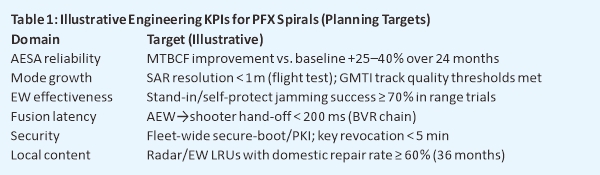
Indicative KPIs and milestones.
These KPIs are engineering waypoints to steer PFX-Alpha spirals; the precise values will be tuned as flight-test evidence accrues. The governing idea remains constant: own the brains and the network, shorten the upgrade loop, and make sovereignty durable through tooling, test, and software ownership.
JF-17 Block III: Avionics, Radar, and Cockpit
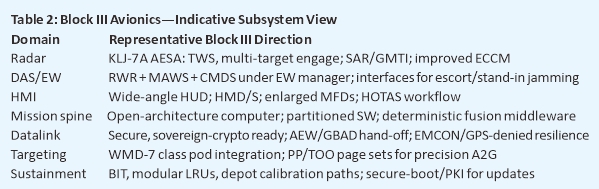
Block III is the operational bridge into the PFX era. Its centrepiece is the NRIET/CETC KLJ-7A AESA radar, wrapped in a modernised mission-computer spine, an integrated defensive-aids suite (DAS), and an updated human.machine interface (HMI) comprising a wide-angle HUD and helmet-mounted display/sight (HMD/S). The design intent is twofold:
(i) Shift the JF-17 from a budget multi-role fighter to a BVR-first light fighter with credible electronic protection; and
(ii) Provide an open, software-forward backbone for rapid capability insertion in the PFX spirals.
KLJ-7A AESA radar (modes, reliability, growth). KLJ-7A replaces the earlier mechanically scanned KLJ-7 with a solid-state AESA that supports multimode tasking. Air-to-air modes include search, track-while-scan (TWS), and multi-target engagement; air-to-surface modes include strip/spot synthetic aperture radar (SAR) and ground moving target indication (GMTI). In maritime roles, sea-search and surface-track modes support anti-ship targeting. Open literature attributes improved ECCM and LPI behaviours to the array’s agile beam forming; vendor quoted figures (as relayed by trade media) describe fighter-sized detections at nominal ranges with the ability to track on the order of 15 targets and engage several concurrently. Architecturally, Block III emphasises reliability and maintainability: modular line-replaceable units (LRUs), on-board built-intest (BIT) for fault isolation, and thermal design choices (air-cooled subarrays) intended to balance cost, weight, and mean time between critical failures (MTBCF). Growth provisions include room for mode expansion (e.g., higher-resolution SAR, cooperative EW-assisted modes) and tighter coupling to the mission-computer fusion layer.
Defensive-aids suite and EW coupling. Block III’s defensive-aids suite (DAS) integrates a radar warning receiver (RWR), missile-approach warning sensors (MAWS), and a countermeasures dispensing system (CMDS) under unified control. The EW manager fuses RWR and MAWS cues with radar/HMD/S symbology to shorten pilot reaction time and to coordinate expendables and jamming under emission-control rules. In line with PFX’s “EW-as-a-system” intent, the Block III avionics spine exposes interfaces for external escort/stand-in jammers and future AESA-assisted jamming behaviours, while enforcing deconfliction so self-protection effects do not blind own-ship sensors.
Cockpit & human machine interface. The HMI moves to a pilot-centric layout: a wide-angle holographic HUD for primary flight and weapon symbology; a helmet-mounted display/sight (HMD/S) enabling high off-boresight cueing and cue-to slew of sensors and missiles; and enlarged multi-function displays (MFDs) with page sets for radar, EW, stores, and targeting pod video. Hands-on-throttle-and-stick (HOTAS) mappings reduce head down time for air-to-air merges and time-critical surface strikes. Symbology integrates datalink tracks (friend/hostile/unknown), EW threat rings, launch-acceptability regions (LAR) for BVR shots, and cueing for PL-10-class WVR missiles.
Mission computer, data buses, and software. Block III’s mission-computer spine adopts open-architecture design: clean interface control documents (ICDs); partitioned software to separate safety-critical functions from mission apps; deterministic middleware for sensor fusion; and digital backbone buses (hybrid Ethernet/MIL-STD style) for growth. This enables:
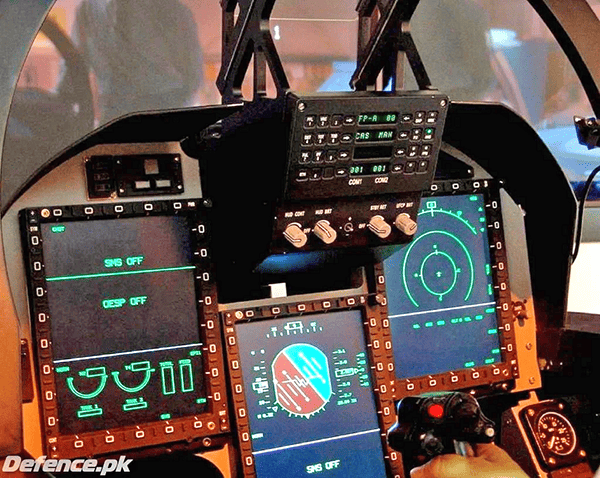
with built-in symbol generation capability. It incorporates an electronic flight instrument system (EFIS).
1. rapid mode insertion for radar/EW,
2. plug-in drivers for new sensors and weapons,
3. low-latency fusion of on-board and off-board tracks, and
4. exportable software partitions for feature-tiering.
Built-in-test, crash/error logging, and sovereign code-signing/secure-boot are used to harden field updates and preserve data rights.
Sensor fusion and AEW/GBAD hand-off. The avionics layer fuses KLJ-7A tracks with HMD/S line-of-sight, DAS cues, targeting-pod video, and off-board datalink tracks (e.g., AEW hand-offs). Operator-visible effects include: stable track quality across sensors, lower shot-latency for BVR employment, and improved ID confidence when EO/SAR corroborates radar returns. Planning targets for the PFX era emphasise sub-200 ms hand-off latency from AEW to shooter for BVR stacks and robust operation under EMCON or GPS denial (via INS centric timelines and waveform agility).
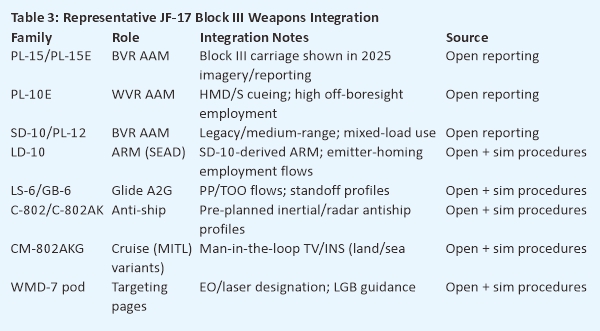
Targeting and stores (management context). Block III commonly pairs with the WMD class targeting pod for EO/laser designation. Stores management software spans BVR/WVR A2A (e.g., PL-15/PL-10 families where integrated), precision A2G glide weapons (e.g., LS-6/GB-6 series), maritime missiles (e.g., C-802/CM-802AKG), and SEAD options (e.g., LD-10), with page sets for pre-planned (PP) and target-of-opportunity (TOO) flows.
Growth, maintenance, and sustainment. Block III’s avionics were specified with sustainment in mind: fast LRU swaps, accessible trays for radar/EW modules, and support tooling for BIT and calibration at PAC depots. Software refresh cadence is governed by flight-safety gates and cyber/crypto policies (secure-boot, PKI, and emergency key revocation). These practices tie directly to sortie-generation metrics and underpin the PFX goal of shortening the sensor/software upgrade loop.
Weapons Integration
Block III shifts the JF-17 from a budget multi-role fighter to a BVR-first light fighter with credible standoff and SEAD options, while preserving growth room for PFX spirals in radar/EW and networking. This section summarises air-to-air, air-to-surface & maritime, and SEAD/DEAD integrations for procedural context.
Air-to-Air (BVR/WVR)
BVR : Open-source imagery and defence reporting in 2024.2025 confirm the carriage of the PL-15/PL-15E family on JF-17 Block III airframes, marking the platform¡¯s intended move to a long-range BVR posture. Earlier SD-10/PL-12 remains in service as a cost-effective medium-range option and for mixed loads.
WVR : The PL-10E combined with the Block III HMD/S provides high off-boresight cueing and closein agility. The cockpit/HOTAS updates and datalinked track symbology shorten the sensor-to-shooter loop in merges.
Air-to-Surface & Maritime. Block III’s stores management and mission computer support a mixed A2G/maritime loadout consistent with prior public material on the JF-17 family. Representative categories include:
• Precision glide munitions: LS-6/GB-6 families (pre-planned and target-of-opportunity workflows), providing JSOW-like employment logic.
• Maritime/land-attack: C-802/C-802AK (pre-planned and inertial/radar-guided antiship) and CM-802AKG man-in-the-loop cruise missile (TV/INS), used for land/sea targets depending on variant.
• Targeting/sensor pods: WMD-7 EO/laser pod for search/track/designation and LGB guidance; cockpit pages provide PP/TOO flows, video, and line-of-sight cueing. Operational specifics vary by customer configuration and export controls;
in all cases, standoff employment doctrine integrates AEW hand-offs and GBAD deconfliction through the datalink layer.
SEAD/DEAD. For suppression and destruction of enemy air defences, Block III leverages the LD-10 anti-radiation missile, an ARM derived from the SD-10/PL-12 body with a passive seeker for emitter homing. In PFX spirals, EW orchestration (RWR/MAWS, AESA-assisted jamming, and escort jammer control) is intended to reduce EW fratricide and to shape survivable ingress/egress windows for ARM shots.
Stores management, datalink employment, and fusion. The stores management system (SMS) communicates with weapons via a MIL-STD-style digital bus and presents PP/TOO flows for glide weapons, ARM hand-offs, and antiship profiles. The fusion layer combines KLJ-7A tracks, EW cues, HMD/S line-of-sight, and AEW datalink tracks for mid-course updates (BVR) and launch acceptability region (LAR) computations. PFX targets sub-200 ms AEW¡æshooter hand-off to improve first-shot probability in BVR stacks.
Configuration variance and export posture. Exact weapon compatibility depends on customer licensing, export approvals, and software baselines. Programme practice emphasises partitioned software so export tiers can be configured without exposing sovereign ECCM, threat libraries, or datalinks.
Exports, Sustainment, and MRO Implications
PFX treats sustainment as a design domain, not an afterthought. Pakistan Aeronautical Complex (PAC) Kamra¡¯s factories.notably the Avionics Production Factory (APF) and Aircraft Rebuild Factory (ARF).provide the industrial backbone for line, intermediate, and depot maintenance, with an explicit roadmap to expand radar/EW repair and software sustainment as PFX spirals mature. For export users, the same infrastructure enables MRO, spares pooling, and upgrade paths aligned to partitioned software baselines.
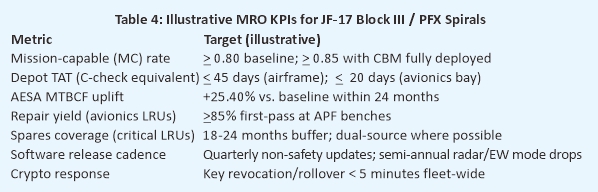
Sustainment philosophy and industrial posture. The near-term goal is assured readiness: keep mission-capable (MC) rates high via fast line-replaceable unit (LRU) swaps, strong depot capacity, and tight feedback from flightlines to engineering. Structurally, the JF-17 programme already localises a majority share of the airframe and final assembly at PAC Kamra; PFX shifts more of the high-value sustainment into avionics/radar/EW, shortening upgrade loops and insulating fleets from external shocks.
PAC Kamra roles (APF/ARF) and today’s scope. APF originated as a radar maintenance centre and now covers a wide span of avionics work, including repair/overhaul and MRO for ground and airborne radars, integration, and production support. ARF executes overhauls for fighter/trainer/transports (e.g., JF-17, F-7P/PG, K-8, C-130 props), plus structures and accessories. These roles let PAC perform depot-level inspections, structural work, and avionics repair under one campus, reducing cycle time for major checks and upgrades.
Radar & EW sustainment under PFX. Block III’s KLJ-7A AESA introduces new MRO needs: array health monitoring, subarray T/R module test, and calibration within anechoic facilities. PFX spirals add:
1. Array & RF benches: verification of T/R gain/phase, noise figure, sidelobe control; environmental/thermal screens.
2. Calibration infrastructure: near-field scanning, boresight tools, and automated built-in test (BIT) upload paths.
3. EW complex MRO: DRFM jammers, ESM/ELINT receivers, DASS integration (RWR/MAWS/CMDS) with orchestration middleware.
4. Sovereign software sustainment: beamforming/ECCM code, EW threat-library curation, secureboot/ PKI pipelines for field updates. These investments make radar/EW support domestic, cut shipping delays, and enable faster mode insertions (e.g., SAR/GMTI refinements, cooperative EW behaviours).
Supply chain, spares and repairables. To stabilise MC rates, PAC’s provisioning model builds buffer stocks of high-failure LRUs and dualsources items that cannot yet be localised (notably RF semiconductors and high-power GaN/PAs). Repairables flow to APF benches for triage and board-level fix; rotables (e.g., pumps, actuators) cycle through ARF. Standard work cards and failure trend dashboards drive procurement and obsolescence actions.
Condition-based and AI-enabled maintenance. PFX incorporates condition-based maintenance (CBM): streaming health data from engines, avionics, and AESA BIT is analysed to predict failures and schedule interventions before AOG events. International practice (e.g., USAF’s PANDA predictive-maintenance programme) shows that ML-driven anomaly detection and fleet-wide pattern mining can raise availability and reduce life-cycle cost; PFX adopts the same principles with sovereign toolchains and on-prem data lakes for security.
Software, data rights, and export baselines. Sovereign control of mission-computer images, radar/EW firmware, and threat libraries is central to MRO. PFX standardises:
• Partitioned baselines (sovereign vs. exportable) so exports can be supported without exposing core ECCM or crypto.
• Secure-boot/PKI across mission computers and radios, with emergency key revocation procedures and audit trails.
• Tooling in-country: build servers, code-signing, calibration databases, and EW library management hosted at PAC/NASTP.
Export customer support and regional hubs. For export operators, PAC offers MRO and line-mod services backed by Kamra depots, with options to stand-up second-line hubs (inspection benches, calibration rigs, spares vaults) in-country. Software partitions allow feature tiering to match licensing; common training syllabi and documentation reduce error rates and turnaround time.
Indicative sustainment KPIs (planning targets)
These values are engineering waypoints; actual thresholds will be tuned by flightline evidence and reliability growth curves. The governing idea remains constant: own the sensors/EW/software sustainment stack, reduce external exposure, and convert MRO into an export-grade service line.
Conclusion
This article set out the PFX programme as a systems-first path that shifts the centre of gravity from airframes to avionics, electronic warfare, mission computing, and sovereign datalinks. JF-17 Block III operates as the practical bridge: KLJ-7A AESA, an integrated defensive-aids suite, an open mission computer spine, and a cockpit with HMD/S that together enable a BVR-first posture and rapid capability insertion.
The programme logic consolidates a decouple, spiral, and reintegrate model through PFX-Alpha, using inservice airframes to mature radar, EW, and software increments while de-risking the eventual air vehicle. The industrial posture at PAC Kamra anchors structures, MRO, and avionics work, and provides the scaffolding for deeper ownership of beamforming, EW libraries, and secure waveform management.
Within this architecture, weapons integration across A2A, A2G/maritime, and SEAD is framed as an expression of the avionics spine and datalink fabric rather than a standalone catalogue. Sustainment is treated as a design domain, with APF/ARF capacity, condition-based maintenance, and partitioned software baselines positioned to keep availability high and upgrade cycles short.
In sum, PFX is presented as a governance and integration pattern that continuously inserts sensor, software, and network effects across the force, with JF-17 Block III as the near-term carrier and the industrial base in place to sustain momentum.