

Chinese Predatory Investments Abroad
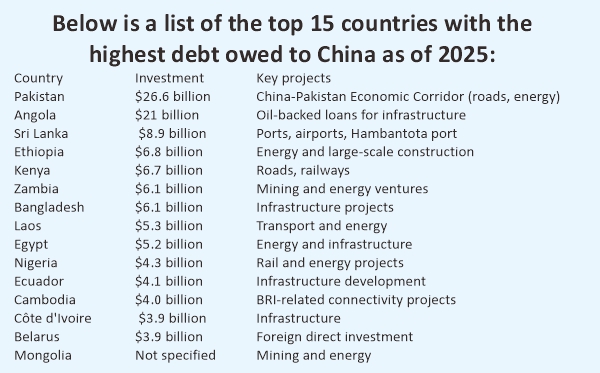
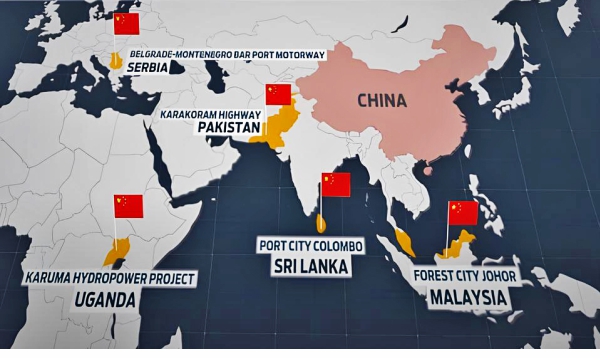
China has lent substantial amounts to various countries for energy and infrastructure projects, primarily under its Belt and Road Initiative (BRI).

These debts reflect China’s extensive global investments in energy, transport, and connectivity projects, often resulting in significant financial obligations for borrowing nations.
Main projects Driving Pakistan’s Debt to China
Pakistan’s debt to China is primarily driven by projects under the China-Pakistan Economic Corridor (CPEC), a flagship initiative of China’s Belt and Road Initiative (BRI). Here are the main projects contributing to Pakistan’s debt:
Energy Projects. A significant portion of Pakistan’s debt stems from energy infrastructure, including coal, hydro, wind, and solar power plants. These projects were designed to address Pakistan’s chronic energy shortages but have resulted in substantial financial obligations due to high-interest loans and capacity payments owed to Chinese companies. Under the Energy Framework Agreement, Pakistan is required to allocate funds to ensure Chinese investors are compensated for any shortfalls, further adding to its financial burden.
Infrastructure Development. CPEC includes the construction of highways and motorways, such as the Karakoram Highway and the Multan-Sukkur Motorway, which aim to improve connectivity within Pakistan and with China. The modernization of Pakistan Railways, including the Main Line-1 (ML-1) project, is another key component of CPEC. This project alone is estimated to cost $6.8 billion.
Gwadar Port Development. The development of Gwadar Port and its associated infrastructure has been a central focus of CPEC. This includes port facilities, an international airport, and free trade zones aimed at making Gwadar a regional trade hub.
Special Economic Zones (SEZs). CPEC includes the establishment of SEZs across Pakistan to promote industrialization and attract foreign investment. However, these zones have yet to deliver significant economic benefits.
Pipelines and Energy Transmission. Projects include oil and gas pipelines as well as energy transmission lines to facilitate energy distribution across Pakistan.
While these projects have improved infrastructure and energy availability in Pakistan, they have also created a heavy debt burden due to high-interest loans, limited economic returns from the projects, and inefficiencies in project management. As of 2023, China accounted for approximately 30% of Pakistan’s external debt, with much of it tied to CPEC-related initiatives.
Debt Converted to Ownership
China’s “debt-trap diplomacy” refers to instances where countries, unable to repay loans for major infrastructure projects funded by China, have ceded control of strategic assets. Below are notable examples where this has occurred:
Sri Lanka. Sri Lanka leased the Hambantota Port to China Merchants Port Holdings for 99 years in 2017 after failing to repay $1.4 billion in loans from China. This has been widely cited as a classic example of debt-trap diplomacy, granting China strategic influence in the Indian Ocean.
Laos. In 2020, Laos ceded a 90% stake in its electricity grid (Électricité du Laos Transmission Company) to a Chinese company after struggling with debt repayments. This move gave China significant control over the country’s energy infrastructure, raising concerns about its ability to influence domestic energy supplies.
Tajikistan. Facing challenges in repaying Chinese loans, Tajikistan reportedly granted mining rights for gold and silver deposits to Chinese companies. This arrangement has been viewed as a way for China to secure valuable natural resources in exchange for debt relief.
Kyrgyzstan. Kyrgyzstan, heavily indebted to China, risks losing control over key infrastructure such as the Bishkek thermal power plant and the Datka-Kemin power transmission line if it defaults on its loans.
Zambia. There have been concerns that Zambia might lose control of ZESCO (electricity company) due to its inability to service Chinese loans tied to energy and infrastructure projects. While no formal transfer has occurred yet, the situation highlights the risks of debt dependency.
These examples illustrate how China’s lending practices can lead to significant economic and strategic leverage over borrowing nations, often involving critical infrastructure or natural resources. However, it is worth noting that some analysts argue that these cases are exceptions rather than standard practice and that many countries willingly accept such terms due to their pressing financial needs.