

South Asia’s security situation is shaped by various factors, including terrorism and long- standing mistrust among neighboring states, several of which are modernizing their militaries and nuclear capabilities. Terrorist activity in Afghanistan and Pakistan will challenge military and security forces, and ongoing tensions along India and China’s Line of Actual Control border demarcation are capable of escalating quickly. Russia and China continue efforts to bring regional powers closer into their respective spheres of influence.
Afghanistan

The Taliban almost certainly will remain firmly in control of Afghanistan during the next year and continue to combat ISIS-Khorasan and anti-Taliban resistance groups, though these groups still conduct deadly attacks in country. The Taliban also continues to restrict al-Qa’ida and its affiliates’ activities in accordance with the Taliban’s perception of its Doha Agreement obligations, though some al-Qa’ida elements probably circumvent these restrictions to provide modest covert support to the Tehrik-e Taliban Pakistan militant group. Low-level Taliban members continue to kill or arrest former Afghan government and military personnel, but senior regime leaders probably are not directing this campaign.
The Taliban has made some progress toward gaining de facto recognition with regional partners, despite persistent concerns about the state of human rights, inclusive representation in government, and militancy in Afghanistan. Iran has met with the Taliban to discuss water rights and threats posed by terrorist groups, particularly ISIS-Khorasan and Jaysh al-Adl.
India is pursuing low-level engagement with the Taliban, focused on humanitarian assistance, countering terrorism, and enabling private sector growth.
• Russia is continuing to deepen its relationship with the Taliban, expressing its intent to formally recognize the government and cooperate against terrorism. In September 2024, the Russia Ministry of Foreign Affairs spokesperson emphasized Russian efforts to remove the Taliban from Russia’s list of terrorist groups and develop multilateral cooperation while blaming the West for instability in the country.
• In January 2024, China’s President Xi accepted the diplomatic credentials of a Taliban- appointed ambassador. The Taliban’s focus on improving internal security and reducing violence has enabled some foreign investments from China, including oil extraction and copper mining activities in Afghanistan.
India
Indian Prime Minister Narenda Modi’s defense priorities will probably focus on demonstrating global leadership, countering China, and enhancing New Dehli’s military power. India views China as its primary adversary and Pakistan more an ancillary security problem to be managed, despite cross-border attacks in mid-May by both India’s and Pakistan’s militaries.
• Following a late April terrorist attack in Jammu and Kashmir, New Delhi conducted missile strikes on terrorism-related infrastructure facilities in Pakistan. The missile strike provoked multiple rounds of missile, drone, and loitering munition attacks, and heavy artillery fire, by both militaries from 7 to 10 May. As of 10 May, both militaries had agreed to a full ceasefire.
To counter Chinese influence and boost its global leadership role, India is giving priority to advancing its bilateral defense partnerships in the Indian Ocean region through exercises, training, arms sales, and information sharing. India also has increased trilateral engagement in the Indo-Pacific region and actively participates in multilateral fora such as the Quadrilateral, BRICS, Shanghai Cooperation Organization and ASEAN.
• In late October 2024, India and China reached an agreement to move forces away from the two remaining contested positions along the disputed Line of Actual Control in eastern Ladakh. The disengagement did not resolve the longstanding dispute about border demarcation but reduced some tension still lingering from a 2020 incident when troops on both sides were killed in a clash along the Line of Actual Control.
India almost certainly will continue promoting its “Made in India” initiative this year to build its domestic defense industry, mitigate supply chain concerns, and modernize its military.
India continued to modernize its military in 2024, conducting a test of the nuclear-capable developmental Agni-I Prime MRBM and the Agni-V multiple independently targetable reentry vehicle while also commissioning its second nuclear-powered submarine to strengthen its nuclear triad and bolster its ability to deter adversaries.
India will maintain its relationship with Russia through 2025 because it views its ties to Russia as important for achieving its economic and defense objectives and sees value in the relationship as a means to offset deepening Russia-China relations. Under Modi, India has reduced its procurement of Russian-origin military equipment but still relies on Russian spare parts to maintain and sustain its large inventory of Russian-origin tanks and fighter aircraft that form the backbone of its military’s ability to counter perceived threats from China and Pakistan.
Pakistan
During the next year, the Pakistani military’s top priorities are likely to remain cross-border skirmishes with regional neighbors, rising attacks by Tehrik-e Taliban Pakistan and Baloch nationalist militants, counterterrorism efforts, and nuclear modernization. Despite Pakistan’s daily operations during the past year, militants killed more than 2,500 people in Pakistan in 2024.
• Pakistan regards India as an existential threat and will continue to pursue its military modernization effort, including the development of battlefield nuclear weapons, to offset India’s conventional military advantage.
• Pakistan is modernizing its nuclear arsenal and maintaining the security of its nuclear materials and nuclear command and control. Pakistan almost certainly procures WMD-applicable goods from foreign suppliers and intermediaries.
• Pakistan primarily is a recipient of China’s economic and military largesse, and Pakistani forces conduct multiple combined military exercises every year with China’s PLA, including a new air exercise completed in November 2024. Foreign materials and technology supporting Pakistan’s WMD programs are very likely acquired primarily from suppliers in China, and sometimes are transshipped through Hong Kong, Singapore, Turkey, and the United Arab Emirates. However, terrorist attacks targeting Chinese workers who support China-Pakistan Economic Corridor projects has emerged as a point of friction between the countries; seven Chinese nationals were killed in Pakistan in 2024.
• Pakistan and Iran have taken steps, including high-level meetings, to deescalate tensions after the two countries conducted unilateral airstrikes on each other’s territory in January 2024 in response to cross-border terror attacks.
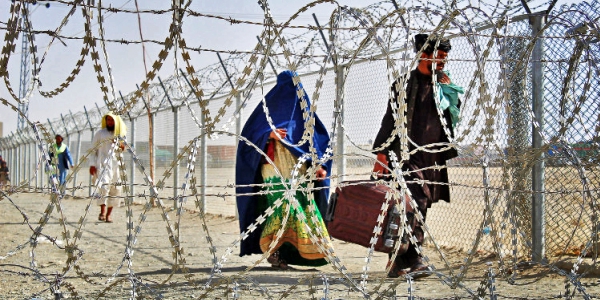
• In September 2024, Taliban and Pakistani border forces clashed near border posts, resulting in the death of eight Taliban fighters. In March 2025, Pakistan and the Afghanistan exchanged air and artillery strikes on each other’s territory, each citing alleged militant infrastructure as the targets.
===
Key Highlights from DIA’s Worldwide Threat Assessment 2025
China’s Strategic Posture:
• Accelerated PLA modernization aims to enable a Taiwan takeover by force if needed.
• Massive investments in nuclear, space, cyber, and disinformation capabilities.
• Expanding global basing and maritime presence from Cambodia to Africa.
Russia’s War Trajectory:
• Sustained war in Ukraine with incremental gains, high human and material costs.
• Increasing use of cyberattacks, space-based weapons, and destabilization operations across Europe and Africa.
Tech-Driven Threat Evolution: AI, space, cyber, biotech, and unmanned systems are reshaping global conflict and espionage strategies.
Rising Adversarial Coordination: China, Russia, Iran, and NorthKorea are intensifying bilateral military, tech, and diplomatic collaboration to counter U.S. influence.
Hybrid and Asymmetric Warfare: From Iranian proxy strikes to North Korean missile exports and cybercrime, non-traditional threats are expanding in complexity and reach.
Homeland Vulnerabilities: U.S. infrastructure faces growing threats from drones, fentanyl trafficking, cyberattacks, and potential terrorist infiltrations via the southern border.
Global Flashpoints: The Taiwan Strait, South China Sea, Red Sea, and Central Asia remain hotspots for escalation with direct implications for U.S. and allied interests.
Bottom line: The security landscape is defined by hybrid conflict, deepening adversarial ties, and accelerating technology disruption.
Strategic foresight and resilience are no longer optional they’re imperative.